Basics of Photography.
Updated: May 29, 2020
I was wondering about what to start with and finally decided to start with something which I believe I am good at - photography. I am here to discuss the basics of capturing a decent picture. This can be the best point to start for beginners.
Photography is one such skill that anyone can develop over time with practice and a lot of patience sometimes.
I was a mobile photographer (for namesake) back in 2015 until the Clix (Photography society of IIT Bhubaneswar) came on my way to introduce me to the whole new world of DSLR (Digital Single Lens Reflex) Photography. I somehow got into the society, learned from my friends, seniors, and more than anyone, youtube taught me a lot. I used to practice back then with the institute's camera and slowly started clicking pictures which finally made me take it as a hobby and I still follow it with my gear - Canon Eos 77D.
So, let's get to the point!!
Though people say there are three main things to be considered while capturing a good picture, I believe in four.
Aperture
Iso
Shutter Speed
Composition ( this will be discussed in one of my upcoming posts)
Too much technical? Aren't they? So, let's get to each one of these in detail.
Photography is all about light and the first three mentioned above helps you in letting the correct amount of light (exposure) enter your camera.
Aperture:
This is something that lets you decide how wide should a lens open. Think it in terms of your eye, the wider you open the more you can see. So there is one number which lets you control this on your camera which is f/number.

(Image Source: shorturl.at/wzFM2)
The smaller the no, the wider the lens open and vice versa. This number also controls the depth of field (DOF) in your picture. Depth of field is how much a picture must be in focus. Smaller the number, blurry the picture is. So, you must have figured it by now that the landscapes which will be in focus completely are taken with higher numbers and portraits with blurry backgrounds with smaller numbers. Here are some examples to make your thought process clear.
This is how the aperture affects the Depth of field.

(Image Source: shorturl.at/gprvV)
Shutter speed: This number decides the amount of time the lens to be open for capturing the image. If the number is small, it freezes the moment (sports photography) but at the same time, letting the lens open for a fraction of a sec makes you compromise on the amount of light entering the lens because Less time= less amount of light entering. So, you need to use shutter speed along with aperture to compose a perfectly exposed picture. This no particularly helps you during sports photography and Long exposure (letting light to enter for more time) photography. So getting to know how an image looks with lesser shutter speed, did you think of any image how it looks when you let the lens be open for more time.
Here are a few examples.

Shutter Speed-25 Secs, Aperture f/22 (Since I want the complete picture in focus), ISO-100.

Shutter Speed-10 Secs, Aperture f/14, ISO-200

Shutter Speed-1/250th of a sec, Aperture f/5, ISO-100
ISO: This is how you control the sensitivity of your lens towards the light. The Sensitivity of the lens is directly proportional to the number you use. Higher sensitivity = More light. At the same time, higher ISO leads to grains in the picture.
But why do you have to control the sensitivity?
Think of a situation where you have to capture an image of a bus moving on a dark road at night. You definitely cannot compromise on shutter speed to shoot a moving bus and you are using the aperture to your best but you still can't see the picture clearly due to underexposure (less light in the picture). So, here is when you try to increase the sensitivity of your lens which adds more light to it.
The below images show you how the ISO affects your picture.
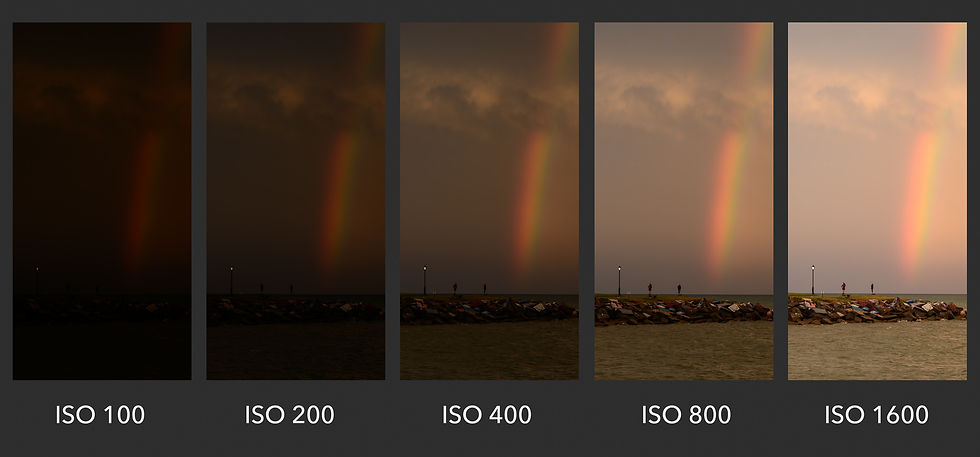
(Image Source: shorturl.at/qtxP0)

(Image Source: shorturl.at/cefs1)
The perfect picture doesn't exist but one needs to experiment with these three elements as a beginner to compose a better-exposed picture.

(Image source: shorturl.at/ekDGKe)
You can experiment with these elements and see the results here.
Here are a few images from my portfolio along with the Exif data used. Give it a thought on how each picture would have changed varying the no's I used.

EXIF: Shutter- 30 secs, Aperture f/22, ISO-100

EXIF: Shutter- 1/60th of a sec, Aperture f/7.1, ISO-100
You can visit my Instagram (@sathwikbobba) to check out my other images.
So, If you are wondering if one needs a good DSLR for good pictures, it's a straight no. There are many successful mobile photographers. Just believe that the gear you have is the best and start capturing. Getting constrained to what you have sometimes let you discover more.
Share your views on the post and any suggestions on the writing are always welcomed!!
-with lots of love.


Mình hay xem soi cầu XSMB với soi cầu MB mỗi ngày để kịp cập nhật trước giờ quay số, coi như thêm góc nhìn cho yên tâm. Ngoài việc đọc dự đoán XSMB, mình còn để ý thống kê lô gan và lô xiên để nhìn ra nhịp xuất hiện của vài bộ số quen. Thỉnh thoảng anh em trong nhóm cũng nhắc tới mấy công cụ như quay thử XSMB, Rồng Bạch Kim và dữ liệu lịch sử, vì dựa vào tần suất thực tế nên dễ soi lại cho rõ hơn. Mình cũng có ghé soicauxsmb.pro ở giữa quá trình tham khảo, chủ yếu để đối chiếu thêm chứ không kỳ vọng gì quá. Nói chung dự…
Mình coi xổ số chủ yếu cho đỡ buồn, kiểu xem cho vui chứ không đặt nặng chuyện trúng hay không. Trước đây nghe tụi bạn bàn về “cầu” này “cầu” kia, mình cũng hóng theo nhưng thật ra mù mờ lắm. Dạo gần đây theo dõi lâu hơn, mình thử để ý xem có gì hay lặp lại không, rồi mỗi lần đọc mấy nhận định thì ghi lại vài ý để sau đó đối chiếu kết quả, coi có phải mình đang tự tưởng tượng ra quy luật không. https://soicauxsmb.io/soi-cau-viet.html Có hôm trúng được chút thì cũng vui, nhưng nhiều bữa sai lệch hẳn, nên mình luôn tự nhắc đừng tin 100%. Với mình, mấy dự đoán này…
Good keep it up
In next start with "how to hold to a camera".