Is Space Tourism Possible?
Have you ever thought of going to space for a few days/months for a trip? (I never thought but who wouldn't if given a chance).
Let's see if that is possible.
Astronomy is one such domain that is not a piece of cake for me for various reasons and most importantly for the technicality involved. So, I tried writing it in the best possible way I can involving the technicality to the least.
Having seen twitter's most trending #LaunchAmerica on 27th May, I wondered what is it all about and later realized that two astronauts named Robert L. Behnken (49) and Douglas G. Hurley (53) are going on a space mission on Dragon 2 (Spacecraft with a capacity to board 7) which is a class of reusable spacecraft developed and manufactured by American aerospace manufacturer SpaceX as the successor to the Dragon 1 cargo spacecraft.
The spacecraft launches atop a Falcon 9 Block 5 rocket and returns to Earth via an ocean splashdown.
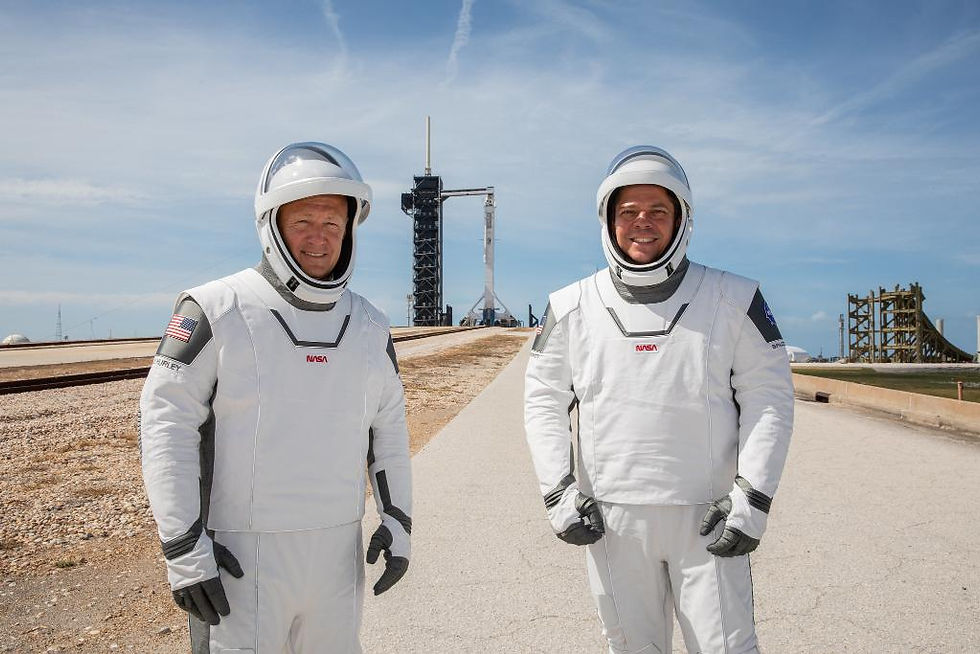
(Image Source: shorturl.at/tHNS8)
After the Columbia accident with astronaut Kalpana Chawla aboard, America stopped using its own rockets for crew launch instead used Russian aircraft. So, this is the first time since 2003 that two Americans are traveling on an American made rocket from American soil.
I was watching the live telecast by NASA last night and the astronauts giving virtual hugs to their families even after standing just a few meters away was the most touching and emotional journey I have ever watched.
History of Space X
With the ultimate goal of making the space flight cheaper so that humans can one day travel to Mars, Elon Musk founded this company in the year 2002. Since then, the company had a series of spectacular breakthroughs and some notable failures too.
In 2008, SpaceX designed Falcon-1 which was the first commercially made rocket to reach the earth's orbit. 2012 is one good year when the dragon cargo vehicle docked(Connected) to the ISS (International Space Station) and three years later, Falcon-9 became the first rocket to land vertically after going to space (This is definitely an innovation as the rocket can be reused which reduces the cost of travel to a greater extent).
Failures are the stepping stones to success and no great innovation comes without failure. So, 2015 is one such year when a rocket without any crew exploded after a few minutes of launch and in 2016, a rocket carrying a satellite exploded while being fueled on the launchpad. Facebook planned to use this satellite to offer internet access to Africa, the middle east and Europe. 2018 is when they launched Falcon Heavy which is the world's most powerful operational rocket and onboard was a Musk's personal Tesla Roadster with a dummy in the spacesuit.

(Image Source: shorturl.at/hijCZ)
2019 is when they started making prototypes that could shuttle people into deep space and today is the reality when the Crew Dragon (Dragon-2) is on the launchpad with the astronauts on board waiting to takeoff.

(Image Source: shorturl.at/hnqu6)
Boeing is the only other company that got approval from NASA for a similar space mission and they are almost ready with their design named "The Boeing CST-100 starliners".
The ultimate goal of this mission is to prove that human travel into space (between earth and ISS to be more precise) is achievable. Onboard are the astronauts along with a Mosaic of the earth made with photographs of around 1,00,000 graduates of 2020 and a "Human Kind" painting by Tristan Eaton.

(Image Source: shorturl.at/pHO28)
Human Kind Painting by Triston Eaton.

(Image Source: shorturl.at/aBDEX)
Let's Dive into the journey of this spacecraft.
If you are wondering about the journey of this spacecraft, have a look at this animated video designed by Space X before going in detail,
Let's classify the whole process into three main categories:
Launch
Docking
Return
Launch:
Let's start with T-0 Minutes (the time when the Falcon-9 lifts off from the ground) and the following image gives you a brief idea on the track of the rocket.
For beginners like me, let's digest the whole process as when the dragon gets separated from the rocket and gets placed in the orbit along with the return journey of the rocket back to the earth for reuse. All it takes is 12 minutes for the dragon to reach the initial orbit and around 19 hours to reach the ISS.
You can see the detailed process in this video for better understanding.

(Image Source: shorturl.at/ptILX)
Docking:
Once in orbit, the crew and SpaceX mission control will verify if the spacecraft is performing as intended and once verified, they stay for a span of 1 to 4 months depending upon various factors. Crew Dragon will perform a series of phasing maneuvers to position itself for docking (joining of two space vehicles) with the International Space Station.
The spacecraft is designed to do this autonomously but astronauts onboard the spacecraft and the Space Station will be diligently monitoring approach and docking and can take control of the spacecraft if necessary.

(Image Source: shorturl.at/cmvRY)
Return:
Upon conclusion of the mission, Crew Dragon will autonomously undock with the two astronauts on board the spacecraft and depart the International Space Station. Dragon will re-enter Earth’s atmosphere after finishing checkups.
Upon splashdown using 4 parachutes (similar to how Airdrop lands in Pubg) just off Florida’s Atlantic Coast, Dragon and the astronauts will be quickly recovered by SpaceX’s Go Navigator recovery vessel and returned to Cape Canaveral.

(Image Source: shorturl.at/agCFM )
This mission was actually scheduled to take off on May 27th, 2:03 am IST from Kennedy Space Center but due to unfavorable weather conditions, the same has been rescheduled for May 30th, 12:52 am. NASA has additional backup launch times planned for May 31 and June 1.
If you wish to get into the details of every step of this mission, it is highly advisable to check out the space X website.
SpaceX already has an agreement with the US space tourism company named "Space Adventures" to fly four passengers as early as late 2021.
Let's together hope that the mission will be a grand success so that we too can travel to space and witness some astonishing live images of the earth one day.
-with lot's of love


keonhacai.cam hôm trước mình thấy bạn bè nhắc nên bấm vào xem thử cho biết thôi. Mình không ngồi đọc kỹ từng mục hay làm gì nhiều, chủ yếu coi giao diện có dễ nhìn không. Vào cái là thấy họ làm kiểu gọn gàng, chia khu vực rõ nên lướt qua cũng nắm được đại khái, không bị cảm giác chữ dồn sát nhau. Mình thích nhất là mấy chỗ hiển thị thông tin theo dạng bảng cột, nhìn khá thoáng và dễ quét mắt, không phải kéo qua kéo lại mới hiểu. Menu cũng để ngay chỗ dễ thấy nên chuyển qua lại nhanh, khỏi phải mò. Nói chung cảm giác dùng nhẹ nhàng, và mấy khối thông…
Bài viết dễ theo dõi, mình đọc một mạch hết luôn, cảm ơn bạn đã chia sẻ. Mình cũng hay theo dõi chủ đề này nên thỉnh thoảng vào xem các nền tảng giải trí trực tuyến để học cách họ chia chuyên mục và bố trí thông tin. Mình đã tự gom lại trên một trang để tiện lưu và xem lại cho gọn. Ai quan tâm thì ghé https://topkif.nvinio.com/Soicauxsmbpro